
Museum the New Llano Colony
Fruits / Propogation
Orchards, Vineyards, Hotbeds, Nursery
"Vernon Parish Democrat," November 11, 1920
"Van Nuland and A. Caron returned from Slagle with an empty wagon, having sold all the apples they hauled over there. They expect to make another trip to Slagle on Monday. They took another load of apples to Leesville this a.m."
"Vernon Parish Democrat," April 28, 1921
"Profitable Industries Which Can Be Established in Vernon -- Some idea of the industrial opportunities which can be established in Vernon Parish will be gained from the following list of mercantile firms which are now lacking.
While it has been proved peanuts can be grown prolifically, yet there is not one peanut butter factory. A good local market exists. Cotton is grown quite extensively, yet there is no cotton products industry. There is no cannery, yet the long growing season makes it ideal for growing vegetables. The poultry industry is merely a barnyard affair, yet climatic conditions and other conditions are most favorable. A wonderful variety of nectarine producing plants offer work for bees through ten months of the years, and apiaries can be made very profitable. The breeding of mules as a business is not followed, though every condition is favorable. Farm products of a vast variety produce well, yet farming is not a leading occupation here.
Vernon is richer in opportunities than the West ever was. Now is the time for alert persons to harvest these opportunities. This parish is on the eve of an awakening which will bring prosperity. Its opportunities cannot longer be hidden."
"An orchard of twenty acres has been planted, the fruit trees being supplied by the government. It is a natural berry country, and many kinds are found growing wild."
"Llano Colonist," January 14, 1928
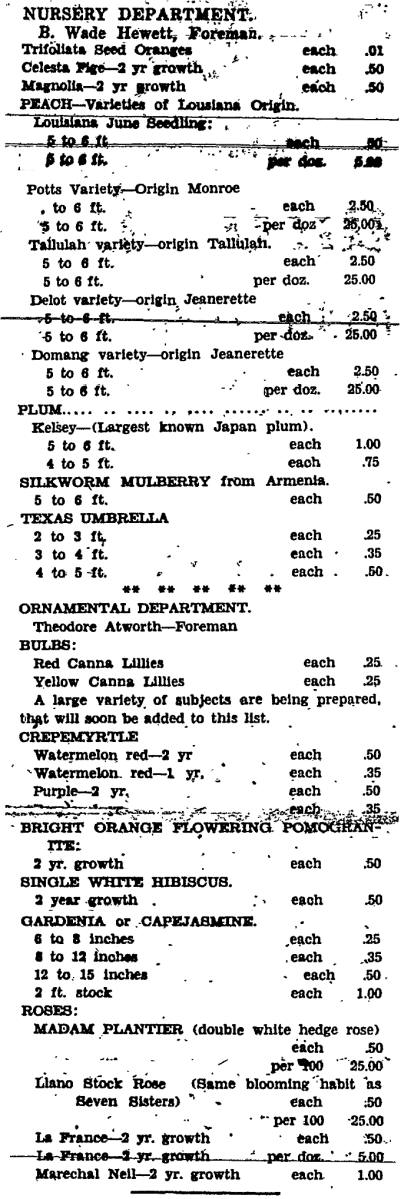
"Young fruit trees are being sold to customers now under permits issued to the colony by the Department of Agriculture at Baton Rouge, certifying that our stock has been inspected and found to be apparently free of especially injurious insects and plant diseases. Whenever we effect a sale of trees or saplings, an invoice stub giving the name of the buyer and the kind of plants sold, is mailed to W.E. Anderson, State Entomologist, at Baton Rouge."
"Llano Colonist," May 26, 1928
"Hewitt is still busy in the orchard and vegetable garden, the splendid appearance of both testifying to the skill, experience and indomitable energy of our chief horticultural and arboricultural expert. He has also cut some honey-combs from our hives and boiled down 8 pounds of wax for his grafting work in the orchard."
"Llano Colonist," February 9, 1929
"Comrade Hough is planting mulberry trees of the silk worm variety, which is an imported variety around our regular fence rows. He is planting them every thirty-two feet and some day they will act as permanent growing fence posts. Who is to say that some day we can quit buying silk because we may be able to produce it here at home. 'Gosh' we girls may be able to pick silk stockings from the Llano fruit trees some day."
"Llano Colonist," Jan 18, 1930
"About the most interesting piece of Colony work I have seen is the flume-heated hot-bed where comrade Ben Roe is planting tomato, cabbage and sweet potato seeds. Hot pipes running underneath nearly the whole length keep the beds at a carefully regulated temperature, tested by a thermometer, and maintained all night by a banked fire. Comrade Palmer and Tom Still, members of the farming crew kept in the Colony center by the storm, were hauling windows with which to cover the hot-bed."
"Llano Colonist," March 1, 1930
"In the home garden, Mr. Johnson and Paul Henry are helping with the hot-beds near the mule barn. One is already up, one is planted, and another is in process of construction. Each is about 150 feet in length. All this work is just for one year for they must be kept free from infection. The flume-heated bed near the hotel has been planted to sweet potatoes and tomatoes. Mr. Peecher and Mr. Joslin keep the fires burning both here and at the bed near the highway. With the co-operation of the men who plan and order supplies, saw, hammer and haul, and with the help of Roy Swenson and Blen Still, I have been covering frames and painting them with parafin --- blankets, sun-shades and waterproofs when the weather is not right for the baby plants."
"Llano Colonist,"April 12, 1930
"Our plant business is being looked after by Comrade Peecher, Senior, at the hot-beds near the store, along the highway and those beds near the garden house; Comrade Johnson and Paul Henry are tending to the beds near the mule barn and are producing wonderfully. Ben Roe says the first, fire-heated bed has already produced about 20 per cent more plants this year than all last season. Add to this two more fire-heated beds and several not warmed by fire and you can get an idea as to what we are doing in selling plants; because we have orders ahead to be filled every day.
Clark is sure having his hands full to keep the packing and shipping going while Mrs. Dougherty and Mrs. Neill, assisted at times by Walt Fread, are mighty busy tending to the regular store business. Surely, they sell plants at the store too. Tens of thousands of sweet potato, onion, cabbage and tomato plants are sold at our store as well as thru the mail orders."
"Llano Colonist," April 26, 1930
"Comrade Peecher kept the fires going under the heated beds when the weather was bad; rain or cold never kept him from attending to his duties, every day he now waters the beds, properly shades them, pulls plants and is always on the job. Also let me tell you that Comrade Johnson, who has other hot-beds and cold-frames to look after is quietly bringing forth a big production of plants that are mostly used by our farmers and gardners [sic]. Paul Henry is his helper, while the other crews on the beds near the store are so varied in number that I cannot keep track of them."
"Llano Colonist," May 10, 1930
"At the cannery -- whoopee -- strawberries mountain high and a whole raft of hullers and cleaners there with Mrs. Killian as major domo."
"Llano Colonist," January 30, 1932
"In Harriman Circle, Taylor keeps enlarging his plant bed area, until now the highway is the limit. James Swenson has the hot-beds lined out there, too, and Layer and Doc Rand are busy fitting up the boiler for the steam heated beds. James has two other long forcing beds filled with sweet potato sprouts, the heat being supplied by layers of manure with a sand cover holding in the heat."
"Llano Colonist," February 13, 1932
"This is the first week of what one might call spring work. Many of the peaches are in full-bloom and the buds on the Mulberry trees are bursted."
"Llano Colonist," March 5, 1932
"The buds on the fig, grape and mulberry trees are beginning to swell and show green. All our strawberry plants were set last winter so none of them have been in the ground more than four months but they have fruit set on them and many berries turning color.
Joe keeps on preparing melon hills in the boys garden while Elmer Jernberg and Quinton Quipp haul fertilizer for the hotel melon patch. We have twenty acres set aside for this crop. Last year we sold several hundred cantaloupes and are making all preparations for a greater acreage, enough for colony use also."
"Llano Colonist," April 9, 1932
"It might not be safe to say aloud but looks as if Spring is here again making new buds in spite of the fact that they lost the first ones by the freeze. The grape and mulberry cuttings are also making new ones. Mr. Duckett and Roslyn have given them wonderful care, as well as the rest of the garden."
"Llano Colonist," August 6, 1932
"The mulberry cuttings are five feet tall and some of the grape cuttings bore fruit this year. Mr. Duckett has eaten some of these grapes and reports the flavor was good. Now can you beat that. 'Nature treats us better than we deserve,' Duckett says. Here he has no trouble to produce four crops a year on this ground and in spite of the long drouth and hot weather over most of June and July we are still eating carrots and beets and have plenty of tomatoes to keep us going and melons three times a day and a few to sell."
"Llano Colonist," October 15, 1932
“Llano Nursery – Shrubbery, Trees, Evergreens, Ornamental Shrubs – Thirty varieties of Choice Rose Bushes; You are cordially invite[d] to visit our Nursery and inspect our stock; Llano Nursery, F. H. Quipp in charge...”
"Llano Colonist," January 13, 1934
"We have put in over 200 fig cuttings. Warren is the one in charge of this job and I am his helper when I can spare the time. These cutting are all from trees of known quality and good bearing ability. Sixty came from the Rice Ranch as we have more desirable soil for rooting cuttings here than they have. Mr. Archer had some good bearing trees at the poultry ranch from which we made nearly a hundred fig cuttings, an accurate record is kept of the origin of every cutting so there will be no guess work. With our climate and soil we should raise all the figs the colonists care to eat and some to sell. (Ben Roe)"
"Llano Colonist," April 14, 1934
"The orchard surely looks fine this beautiful morning, like a flower garden, the pears and plums being in full bloom, the latest they have ever bloomed, as usually they bloom during the latter part of January, thus running a great risk of freezing. The prospects are good for a full crop. The peaches are set and are as large as marbles.
The 112 orange trees, 24 kumquat and a few grapefruit as well as 30 Jujube trees which were set out last fall are all doing fine. To protect against the danger of freezing, Orchardist Hiatt placed tree protectors of his own making around each tree 20 inches high and on the outside of this the trees are banked with pine needles up to the protector and a burlap sack is thrown above the protector to protect the young trees from freezing while small.
Youngberries to the number of 320 were set out yesterday and a like number will be set out today which will complete one solid acre of this valuable vine. Also the crew is completing the setting out of 345 Carmen grapes which are considered the best variety for this section. In addition to this, 66 Zante Corinth grapes were set out. They have also pruned and tied up on wire the grape vines in the old vineyard, ready for the season's cultivation and cropping. It is expected that quite a crop of grapes will be gathered this year. The cuttings from the trees set out for reproducing of additional trees are all quite promising, including pears, apples, plums, peaches and mulberry.
Comrade H.C. Morgan of California has very kindly contributed ten dollars toward getting a vineyard horse-hoe which Ed has been anxious to get for a long time and which will enable him to take care of the orchard and fruit as they should be. Comrade Reo Johnson has also contributed four dollars toward getting this hoe which has already been ordered and should be here within a couple of weeks or less. Ed says if he just had a couple of horses now, he would be all set."
"Llano Colonist," May 18, 1935
"The plums are ripe, come and get them! These plums are a native variety that ripen quite early. We [also] have a large... plum that ripens late in the season and has an exquisite taste. In walking through the orchard I examined some of the pear trees and found pears the size of an English walnut."
"Llano Colonist," July 6, 1935
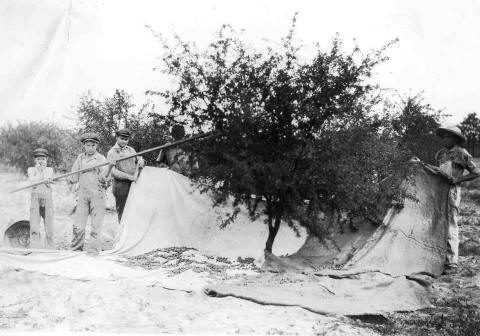
"Duncan was gathering apples to be taken to the hotel. We have some apple trees, not many, and a few of them are loaded down with fruit."
"Llano Colonist," June 6, 1936
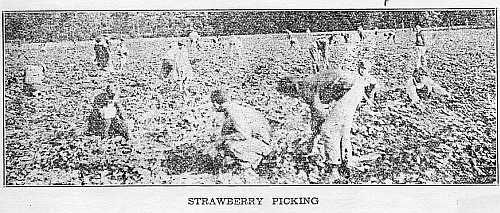
"The youngberries are at their height at present and all hands are at the task of picking them. It's not like picking huckle-berries, where you have to gather millions before you even notice them, but it's amazing to see what a small number is needed to fill a water pail. The pail is filled before you can realize you've even started picking. They sure are a favorite dessert of the Colony, too. At least there seems to be a grand rush for them at the hotel where they are cooked and sweetened for some of evening meals. Too bad the excessive rain of last week spoiled a lot of them on us."
"Llano Colonist," July 25, 1936
"The Llano vineyard produced a large supply of grapes this year, but most of them were picked and preserved in one way and another by individual members of the colony. However, a few persons were community spirited enough to send a portion of what they picked to the hotel, and a good many boxes -- thirty or forty in all -- were brought in there. Some of these were served at the hotel, while Mrs. Hewitt and Mrs. Emery put up the rest in the form of juice, jelly, or grape butter, for use in the hospital or in preparing lunches for night workers. Charley Derleth bought 100 pounds of sugar for their use in preserving this fruit and the pears which will follow."
"Llano Colonist," June 26, 1937
"There is a wild grape in our neighborhood that makes the most delicious jelly and wine, and we have some grapes in our Colony that certainly help out in the food line."


Copyright 2018 Museum of the New Llano Colony