
Museum the New Llano Colony
Peanut Butter
Growing Peanuts, Peanut Butter Plant
"Vernon Parish Democrat," April 28, 1921
"Profitable Industries Which Can Be Established in Vernon -- Some idea of the industrial opportunities which can be established in Vernon Parish will be gained from the following list of mercantile firms which are now lacking.
While it has been proved peanuts can be grown prolifically, yet there is not one peanut butter factory. A good local market exists...
Vernon is richer in opportunities than the West ever was. Now is the time for alert persons to harvest these opportunities. This parish is on the eve of an awakening which will bring prosperity. Its opportunities cannot longer be hidden."
"Vernon Parish Democrat," May 19, 1921
"Geo. Thomas has got the peanut butter infection, and has started the mill to work; he succeeded in turning out some excellent butter and now I see where the factory will be on the big job again. If any of you were fortunate enough to eat Ma Thomas's peanut butter -- well, I see your chance again. One Thomas or the other will keep peanuts and peanut butter in the market from now on, so send in your orders."
"Vernon Parish Democrat," June 9, 1921
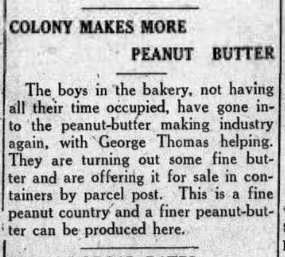
"The boys in the bakery, not having all their time occupied, have gone into the peanut-butter making industry again, with George Thomas helping. They are turning out some fine butter and are offering it for sale in containers by parcel post. This is a fine peanut country and a finer peanut-butter can be produced here. "
"Llano Colonist," December 10, 1927 (Gateway to Freedom)
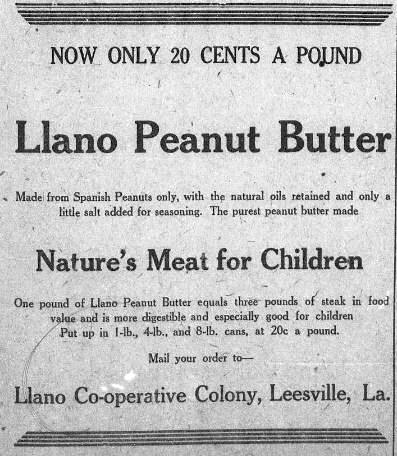
"PEANUT BUTTER -- One of the products for which this country seems extremely well adapted is the growing of peanuts. They reach an exceptionally high quality here. Colony peanut butter, made from Spanish peanuts, is unexcelled. It is planned to expand this into a commercial industry operating on an increasingly large scale from year to year."
"Llano Colonist," August 11, 1928
"Comrades Hough and Shutt are hoeing the peanuts that were planted on the orchard tract. Since the rain they are quite hopeful of a big crop and we will be glad of it. Our farm crew was not very large so we did not get as much land planted as we wanted, hence we are very desirous for mother nature to give us all the lift necessary to supply us for the winter. Especially do we hope for a big crop of peanuts."
"Llano Colonist," October 6, 1928
"Our most important work, at this time seems to be centered around the crop gathering, so Ben Roe, our garden foreman, has transferred most of his crew out to help the farmers to harvest their crops. His crew, along with all the boys and girls that can be spared during their industrial time, are now in the peanut patch plowing, pulling and stacking peanuts. We seem to have a very fine crop of "goobers" this year and we are seeing to it that they will be well taken care of.
Of course you know that most of the nuts will be made into peanut butter and a little later you can get it by making an order through our commercial department.
We also save the tops for hay and I want you to know it is just about as good as alfalfa for all around hay purposes. Especially good for cow feed for our dairy and Van Nuland will see to it later that it is properly stored after the nuts are threshed or separated from the vine.
Now in order to [properly harvest] this crop, a seven foot pole is driven into the ground far enough to support the load that is later put around it. Cross pieces are nailed on this pole about 18 in. from the ground and upon these cross pieces and around the pole, the peanuts, vines and all are stacked, placing the nuts around the pole but leaving room for the air to pass up thru the stack, thus drying the nuts for threshing and storing without danger of heating. Also by this method the hay stays green and holds its food value. Later when properly cured the whole shock, pole and all are loaded onto wagons and hauled to the thresher or picked and then the vines and nuts are separated.
A man, team and plow are used to plow out the peanuts, after which they are picked up and laid in the sun for about half a day before stacking begins.
We raise for peanut butter the Spanish peanut, which is by far the best nut for this purpose. Also we are now raising some extra fine large nuts such as you buy in the market for roasting and eating. Com. Roe is specializing upon this particular nut in his garden work."
"Llano Colonist," October 5, 1929
"Ben Roe is as happy as a kid with new red top boots. The new peanut digger arrived and Ben says that they will be able to finish the peanut job in two more days for the present until about two weeks when more nuts will have to be dug and stacked."
"Llano Colonist," April 16, 1932
"Peanut butter seems to be liked by everyone in the colony and can be traded off for about everything. Peanuts are the easiest crop to raise and we have the soil and climate. So we will increase our acreage every year for some years to come."
"Llano Colonist," September 23, 1933
"Peanut harvest seems to be the chief focus of colony labor these days. I worked at them yesterday myself, and was rewarded with an excellent dinner at the farm, prepared by Mrs. Glavincheff, assisted by her husband, Peter. The peanuts are uprooted with a digger, then we come along, knock the plants together to get the soil off them, and pile them in little rows, from which presently they are gathered up and put into nice, round shocks. The shock is supported by a stake running up through the center. Also they are built up on a sort of cross-shaped affair made of two wide boards. This serves to keep them off the ground and permits the circulation of air underneath. When dry the peanuts are hauled, straw and all, into the big dairy barn, from which they will be threshed."
"Llano Colonist," January 16, 1932
"Great heaps of peanuts are being sorted, roasted and made into peanut butter for home and outside orders."
"Llano Colonist," January 30, 1932
"Of sorting and roasting peanuts there is no end, so saith Killie and her aides in the room off the bakery."
"Llano Colonist," February 16, 1935 by Dr. Robert K. Williams
"Carl Henry Gleeser is thorough. Regardless of the job he undertakes, he believes in doing it well. The job might be editing a newspaper, or writing special articles for the labor press, or hoeing a garden, or grubbing stumps. It does not matter. He is one of Llano's true co-operators. At the present time he is in charge of the peanut butter factory.
The peanut butter department is well hidden from view. It should not be. The early Llanoites apparently did not anticipate Llano peanut butter. For its quality and delicious flavor it deserves to be housed in a fine, modern, up-to-date structure. Its taste would do honor to the most sensitive palate. I entered the peanut butter department from the bakery. There is a rear entrance, or shall I say exit, that leads to the grounds in back of the grist mill. I told "Dad" Gleeser that I wanted to write up a diary story on the making of peanut butter. Would he give me some facts and figures? Of course.
Peanuts are first thrown into the huller. The huller takes off the shells. The shells are blown out of the window to a repository. The peanuts, minus the shells, fall into a box on the side of the huller. Do you think the shells are wasted? Not on your life. The shells are first allowed to rot then used as fertilizer in the garden and on the farm. As 'Dad' Gleeser says, 'Nothing is wasted.'
The shell-less peanuts are then spread upon a table and separated into three compartments. "Dad" has three helpers who aid him in the sorting. They are Mrs. Mina Lewis, Mr. Fall, who regularly works in the peanut butter department, and Mr. Banta, a temporary worker. The three compartments are (1) the splits -- that is the peanuts that are halved and quartered in the process of hulling; (2) the whole nut, and (3) the unshelled peanuts. Some peanuts come out of the huller unshelled. They are deposited again and again until finally shelled. The unusable peanuts are segregated and fed to the chickens.
The splits and the whole nuts are then, separately, roasted in a gasoline-motored roaster for about twenty minutes or so. That depends on the outside temperature and the temperament of the roaster. The peanuts are cooled in pans after the roasting and then they are run through a blancher, which takes off the outside skin, The peanuts are then put into the butter mill. Burrs grind the peanuts up into a floury substance, which, mixed with the natural peanut oil and slightly sprinkled with salt, comes out of the mill as peanut butter. No oil substitutes are used. Llano peanut butter is a natural, rich, and delicious food.
Carl Henry Gleeser takes pride in his work. It does not matter what his work is. Carl is proud of the Llano peanut butter. He maintains that if sufficient peanuts can be grown, and if he is given sufficient help, he can turn out twelve to fifteen hundred pounds of peanut butter a day. And, I add, properly advertised, Llano can find a market not only for twelve or fifteen hundred pounds a day, but for double and triple that amount. You have but to taste it."


Copyright 2018 Museum of the New Llano Colony