
Museum the New Llano Colony
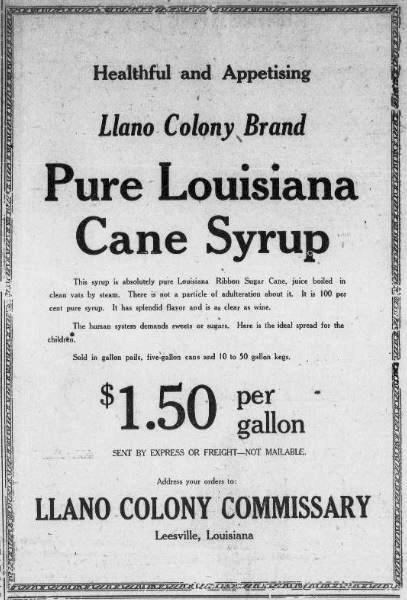
Sugar / Sweeteners
Sugar Cane, Sorghum, Honey
"Vernon Parish Democrat," April 28, 1921
"In the cane growing, the Colony was very successful, having made 1700 gallons of pure sugar cane syrup and 700 gallons of sorghum molasses, much of which will add to the source of income to the Colony."
"Llano Colonist," December 3, 1927
"One of the main industries of Louisiana is the growing of sugar cane and the making of syrup and sugar. It does well on colony lands.
Out on the farm Tom Davidson has divided his crew. Some of them are continuing to dig sweet potatoes while others are getting ready to harvest the sorghum. Alex, Harry and Warren came to town with the Fordson to haul out the cane crusher and no doubt, before this week is over Dad Craft will be boiling sorghum syrup. The harvesting of the sugar cane will also be done at this time before the cold weather hits us hard enough to freeze the cane buds."
"Llano Colonist," December 10, 1927
"After the sorghum is all pressed and cooked, the sugar cane will get the same operation performed on it, excepting that which is buried for next year's seed. You see the cane stalks are used as seed in this country."
"Llano Colonist," November 3, 1928
"Our good co-worker Hoag, has been re-building the syrup pan, and it is just about ready to be moved to the cane mill, and be placed over the furnace. Waters, Craft and Turner are centered on getting barrels, pails, strainers, wood and helpers together to begin operations."
"Llano Colonist," November 10, 1928
"Joe Turner has placed the syrup pan for cooking the sorghum and Chas. Black started cutting the cane this P.M. Joe intends to make the syrup this year and if he can make the syrup as well as he makes candy we will all have a treat of sweets from his efforts.
After lunch I strolled out to see what the sorghum makers were doing and I found a real efficient line up at work. Ben Roe was looking after the engine and machine work. Com. Gregson was feeding the cane crusher and Dixon was placing the cane upon the feed table. Mardfin, Hough, Bingham, Silberman and Rahn were topping the cane (cutting the seed off for chicken feed) while Ward Shoemaker was carrying from the toppers over to Dixon's platform. Joe Turner is doing the evaporating and they think they can finish the job in two days more."
"Llano Colonist," March 3, 1928
"The sugar cane is all planted at this time and Ashlock has gone back with Roe, Waters and Baker who work the farm at this time."
"Llano Colonist," October 5, 1929
"For immediate work the sorghum making will come next, Norton, Neal, Brannon and Clutter have been stripping the cane and in another day or two syrup-making will start; after that the making of ensilage at the dairy for our cows."
"Llano Colonist," October 12, 1929
"Today the farm crew finished up with the making of sorghum 'lasses' and although the crop was not sufficient to carry us thru the winter, every little bit helps and we are glad to get these odd jobs off our hands as rapidly as possible."
"Llano Colonist," July 5, 1930
"We harvested the sugar beets this morning -- not much of a crop in itself, but big in suggestion. For those of us who have always gone to the store for everything it is an experience to see a group of three hundred people aiming at producing all they need. Yesterday I heard them planning how to make our own syrup from our sorghum crop. Can we grow beets for sugar and cotton for clothing? (Mrs. Still)"
"Llano Colonist," October 18, 1930
"Comrade Coen has taken upon himself the job of fixing the kiln where we will boil the syrup. He is going to be chief cook in making syrup. Comrade Hoag and Reddy are fixing the pans, and Comrade Hiatt and his crew are stripping the cane getting it ready to be run through the mill."
"Llano Colonist," October 25, 1930
"Every available man, woman and child is today in the cane patch stripping cane which is being hauled to the mill where the juice is squeezed out and Comrade Coen is making it into syrup...
Stripping and hauling cane goes on, and "winding and grinding" round goes the sorghum mill. We will swim in treakle pretty soon. The pigs are fattening on the cane seed and we should like to feed it to the cows but they say it dries them up...
A week of great hustling, especially on the sugar cane. It was a fine spectacle to see from twenty to thirty in the cane field, stripping, cutting the heads off, cutting the cane and piling it in shape for the teamsters to haul to the sugar house. More than fifty loads went up there and we have four barrels of syrup, clear and yellow as honey, and less than half of the field harvested. The tops are cut off and the ripest and best looking are saved for seed. The rest is fed to the hogs. The leaves are fed to the mules. The bagasse is cut up and put in the silo, for the cows. The syrup is forwarded to the store house and eventually finds its way to the tables.
Thus the cane field cares for everything save the hens. It involves a great amount of labor to do this. Names of all who were doing the work cannot be furnished. The silo was taken care of by Harold Kemp, Robert Roe, Benson Matus and Ward Shoemaker. They did a good job as also did the rest of those who were on this work. It is hoped to complete the sugar cane this coming week. Other crops are waiting for quite as much exertion to save them as is the cane. Peanuts and sweet potatoes are all crying for attention and will have it as soon as the cane has been taken care of."
"Llano Colonist," November 1, 1930
"Down at the cane field where Comrade Hiatt has his crew stripping and cutting sorghum that is being delivered by the farm crew out to the place where it is pressed and the juice made into sorghum syrup for our use. This crew is working, particularly at this sorghum manufacture, also recognizes the fact that the peanuts must be harvested very soon, in order that we may get the best from the crop, especially from the leaves and vines which make as good a variety of hay as alfalfa...
Comrade Hiatt and his gang of sorghum strippers have been nailing to the job in order to keep the sorghum makers busy, turning out at least a barrel of syrup a day...
"Llano Colonist," November 8, 1930
"At last the sugar cane is all in store. Now we have more than five hundred gallons of syrup made, some already consumed and delighted fellows to consume it. Good syrup too, made by Frank Nelson who does not pose as an expert but has proved to be one."
"Llano Colonist," September 5, 1931
"The sorghum mill is running and sorghum is being boiled and will be ready for service in all our departments in the next few days. My, ain't we glad! and you'll see us get fat on genuine home-made cane molasses! We don't want no white sugar but we sure do like to lap up them molasses! Ben Couchman is gathering in all the big red barrels and cleaning them up and putting them in readiness for the limpid treakle which is in process of boiling down out on the farm."
"Llano Colonist," November 14, 1931
"Mardfin is cutting the sugar cane in the field east of the printshop. I understand that the cane is to be bedded and used in the spring for seed for a big patch. This cane, I am told, is free from the cane borer that destroyed our former planting of cane. Ten years ago we had a harvest of 1400 gallons of ribbon-cane syrup, the finest cane sweet in the world."
"Llano Colonist," April 2, 1932
"The sugar cane that was buried all winter, is now being dug up and Karl Nelson is hauling it down to the "Gass place" to be planted there for the season. The cane grows out of the joints of the stalks and not out of seed up here. Before the cane borer got into our supply of cane we made a fine product of blue ribbon cane syrup, and now again we may be in a position to do so."
"Llano Colonist," April 16, 1932
"Sam Klette discussed the new unit in the Sugar Bowl of southern Louisiana -- bordering right on the Gulf, at Thibodaux, the place is known as the Isle of Cuba Plantation. Worked first by negro slaves, then with 'emancipation', workers who were serfs just the same (they weren't even allowed to grow a garden, raise chickens, or keep a cow, but must purchase everything from the company store.) In time, however, competition and tariffs put the grasping landlord out of business; the property was abandoned and the bank took over.
Sam, who will have charge of the unit, is interested in stocking the place with bees. He could buy from a neighboring bee grower, Italian bees at $5.00 the colony, and the abundance of white clover growing in the region would provide for their needs year round."
"Llano Colonist," July 2, 1932
"We are developing a bee unit at Patterson, La. From it we should get our sweets."
"Llano Colonist," August 6, 1932
"Sixty six hundred and sixty five pounds or more than THREE TONS of honey arrived in the colony today, trucked from Lake Charles, where the immense pile of sweets arrived from California by boat.
Warren Fread, Harold Kemp and Harry Rennick brought the valuable load of sweets to the colony and so anxious were they to get here the truck hit a "blue ribbon" pig and sent it to pig heaven. The owner happened to be nearby and after a lengthy argument five cans of honey was handed over to him to assuage his grief and pay for the hog.
A broad smile of welcome awaited the honey and immediately a supply was sent to the commissary, and Walter Fread, Mrs. Baldwin and Bonnie Kemp were busy handing it out to those desiring a week's supply. This is the way things are done here.
I took some of it home, about a pound and I want to say it is the real thing. It is perfectly delicious and the aroma of flowers of the northwest brings back the pleasantest of memories.
Our very good friend George Bancroft of Oregon is most cordially thanked for his generosity and his thoughtfulness in the matter of seeing that the colony is supplied this fine shipment of honey. He has been, of course, officially notified of its arrival and thanked accordingly. -- (R.K.W.)"
"Llano Colonist," December 10, 1932
"Tonight there was a meeting in General George's office concerning the Sugar Bowl Unit. It was decided to have Mitch take a truck down and stay a day or two to fix up the tractors. Earl Swenson and Jimmie Nash will go to stay and drive the tractors until they have 500 acres plowed, which will be planted to sugar cane.
Then other colonists will join them to cut sugar cane and take it to the mill where it will be turned into sugar, syrup or cash for the benefit of the colonists. It certainly looks as if this unit is about ready to take off and we have to give much credit to the boys who are there for putting it over as they have had a difficult situation to meet."
"Llano Colonist," January 7, 1933
"Back of the planing mill, Ault, the bee man, and his assistant were tuning up their home -- on wheels. Ault is a Texan by birth and a bee expert by nature. He is enthusiastic about stocking up our different units with bee colonies so that we may use honey instead of sugar, which is best for the human critter in every way. He says we can easily stock-up the Patterson unit with a hundred colonies as the flower growth in that region will support almost unlimited quantities of colonies. And not only that, but colonies may be moved from one region to another to suit the rotation of honey flows. Ault also proposes stocking Ole at Premont, Texas, with several bee colonies. He's a live wire for certain."



Copyright 2018 Museum of the New Llano Colony